

Which Bar Length Suits a Gasoline Chain Saw for Hardwood?
2026-10-12
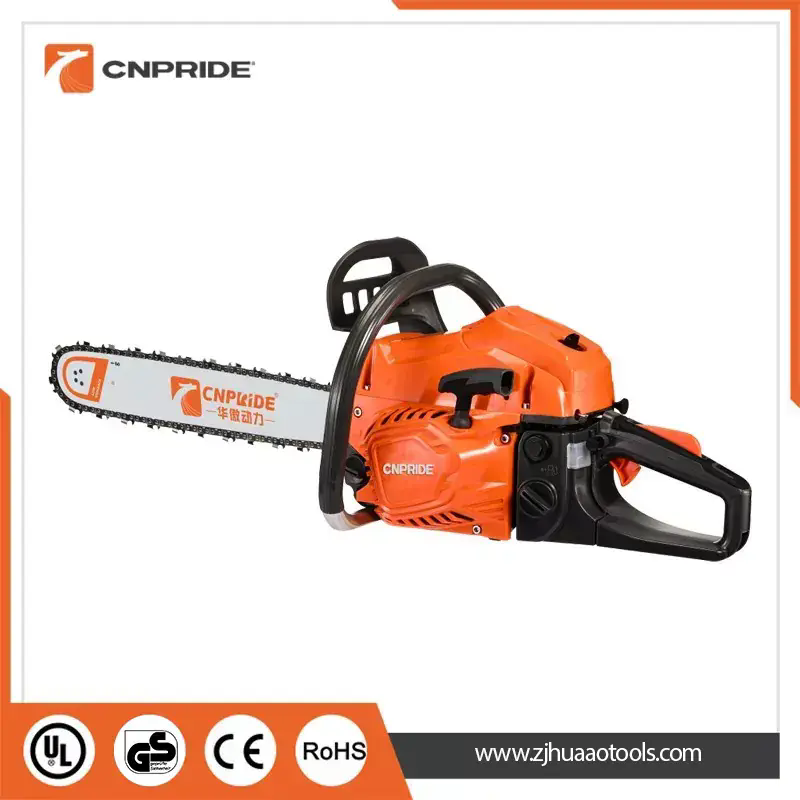
A forestry contractor is felling 60-year-old oak with a Gasoline Chain Saw. The saw is a 50 cc professional model with a 20-inch bar. The chain is sharp, the tension is correct, and the fuel mix is right. But the saw cuts slowly, the engine boggs down in the cut, and the bar overheats. The contractor switches to a 16-inch bar on the same powerhead. The cutting speed increases by 40 percent, the engine maintains RPM, and the bar stays cool. The difference is not the saw. It is the bar length. In hardwood, the bar length determines the chain speed and the torque delivered to the cut. A bar that is too long for the engine displacement will reduce cutting efficiency and increase wear. This guide explains how to match bar length to hardwood cutting.
1. How Does Wood Density Affect the Power Required for Cutting?
Hardwood species such as oak, maple, beech, and hickory have a higher density than softwoods such as pine, spruce, and fir. The density determines the specific cutting resistance, which is the force required to remove a unit volume of wood. The higher the density, the more power is required to maintain the chain speed. The table below shows the density and cutting resistance for common hardwood and softwood species.
| Species | Density (kg/m³) | Specific cutting resistance (N/mm) | Power required for 16-inch bar (cc) |
| Oak (red) | 700 | 28 | 45 – 50 |
| Maple (hard) | 720 | 30 | 50 – 55 |
| Beech | 710 | 29 | 48 – 52 |
| Hickory | 770 | 34 | 55 – 60 |
| Pine (soft) | 450 | 18 | 30 – 35 |
| Spruce (soft) | 430 | 16 | 28 – 32 |
The power required for hardwood cutting is 50 to 80 percent higher than for softwood of the same diameter. A Gasoline Chain Saw that is adequate for a 20-inch bar in pine may only be adequate for a 14-inch bar in oak. In our factory, we recommend that the engine displacement be matched to the bar length and the wood density. Zhejiang Huaao Power Machinery Co., Ltd. has been manufacturing Gasoline Chain Saw units for over 15 years.
2. How Does Bar Length Affect Chain Speed and Torque?
The bar length determines the number of drive links in the chain and the total length of the cutting loop. A longer bar has more drive links, which increases the friction and the weight of the chain. The increased friction reduces the chain speed for a given engine power. The chain speed is the primary factor in cutting efficiency. A chain speed of 20 to 25 m/s is optimal for hardwood. Below 15 m/s, the chain tends to grab and the cut is slow. Above 30 m/s, the chain wears rapidly and the risk of kickback increases. The table below shows the relationship between bar length, engine displacement, and chain speed for hardwood.
| Bar length (inches) | Drive links | Recommended engine displacement (cc) | Chain speed at 10,000 RPM (m/s) | Suitability for hardwood |
| 14 | 52 | 40 – 45 | 22 | Excellent |
| 16 | 60 | 45 – 50 | 20 | Very good |
| 18 | 68 | 50 – 55 | 18 | Good |
| 20 | 76 | 55 – 60 | 16 | Fair (marginal) |
| 24 | 84 | 65 – 70 | 14 | Poor |
| 28 | 92 | 75 – 80 | 12 | Not recommended |
In our factory, we test the chain speed of different bar and engine combinations on a dynamometer. The data shows that for a 50 cc engine, the chain speed drops from 22 m/s with a 14-inch bar to 16 m/s with a 20-inch bar. The 16 m/s chain speed is marginal for hardwood because the chain tends to stall under load. Zhejiang Huaao Power Machinery Co., Ltd. provides a bar length recommendation chart with every Gasoline Chain Saw.
3. What Is the Relationship Between Bar Length and Cutting Technique?
The bar length also affects the cutting technique. A longer bar allows the operator to cut larger diameter wood without repositioning. But it also increases the weight of the saw and the leverage that the operator must control. For hardwood felling, the bar length should be at least 2 inches longer than the diameter of the tree at the felling height. For bucking, the bar length should be at least the diameter of the log. The table below shows the recommended bar length for different cutting tasks in hardwood.
| Cutting task | Typical wood diameter | Recommended bar length | Minimum engine displacement |
| Limbing and brushing | < 8 inches | 12 – 14 inches | 35 – 40 cc |
| Felling small hardwood | 8 – 14 inches | 16 – 18 inches | 45 – 50 cc |
| Felling medium hardwood | 14 – 20 inches | 18 – 20 inches | 50 – 60 cc |
| Felling large hardwood | 20 – 30 inches | 20 – 24 inches | 60 – 70 cc |
| Bucking large logs | 20 – 30 inches | 24 – 28 inches | 70 – 80 cc |
Field tip: For hardwood felling, a shorter bar with a higher chain speed is often faster than a longer bar with a lower chain speed. The operator can make two cuts (one from each side) with a 16-inch bar faster than one cut with a 24-inch bar on a 20-inch tree. The shorter bar also reduces the weight and the kickback risk. In our experience, most hardwood felling in the 12 to 20 inch range is best done with a 16 to 18 inch bar on a 50 cc saw.
4. How Does Chain Type and Sharpening Affect Bar Length Selection?
The chain type and sharpening angle affect the cutting efficiency and the power required. A full-chisel chain cuts faster than a semi-chisel chain but requires more power. A semi-chisel chain is more forgiving in dirty wood and holds its edge longer. For hardwood, a semi-chisel chain with a 30-degree top plate angle is a good compromise between speed and durability. The table below shows the recommended chain type and sharpening angle for different hardwood conditions.
| Wood condition | Recommended chain type | Top plate angle | Depth gauge setting |
| Clean hardwood | Full-chisel | 25 – 30 degrees | 0.025 inches |
| Hardwood with dirt | Semi-chisel | 30 – 35 degrees | 0.025 inches |
| Frozen hardwood | Semi-chisel | 35 degrees | 0.020 inches |
| Very hard hardwood (hickory) | Full-chisel | 25 degrees | 0.020 inches |
In our factory, we recommend that the depth gauge setting be reduced for hardwood to prevent the chain from grabbing. A depth gauge of 0.020 inches produces a smaller chip and reduces the load on the engine. This allows a longer bar to be used without stalling. Zhejiang Huaao Power Machinery Co., Ltd. provides a sharpening guide with every Gasoline Chain Saw.
Frequently Asked Questions About Bar Length for Hardwood Cutting
Summary for Forestry Contractors and Arborists
Bar length selection for hardwood cutting is a balance between cutting capacity and chain speed. A bar that is too long reduces the chain speed and the cutting efficiency. A bar that is too short limits the diameter that can be cut. The optimal bar length depends on the engine displacement, the wood density, and the cutting task. For a 50 cc saw in hardwood, a 16 to 18 inch bar is the best choice. The chain type and sharpening angle also affect performance. Zhejiang Huaao Power Machinery Co., Ltd. has been manufacturing Gasoline Chain Saw units for over 15 years and provides bar length recommendation charts for all of our models.
Zhejiang Huaao Power Machinery Co., Ltd. manufactures Gasoline Chain Saw units with engine displacements from 35 cc to 80 cc, and bar lengths from 12 to 28 inches. We provide bar length recommendation charts, chain sharpening guides, and oil pump specifications for all of our products.