

How to Choose and Use Laser Rangefinder Modules for Accurate Measurements?
2026-01-04
Abstract: Laser Rangefinder Modules are essential tools for precise distance measurement across multiple industries. This article explores how these modules work, how to select the right model, and common usage scenarios. It includes detailed specifications, practical guidance, and answers to frequently asked questions to help engineers, hobbyists, and professionals make informed decisions.
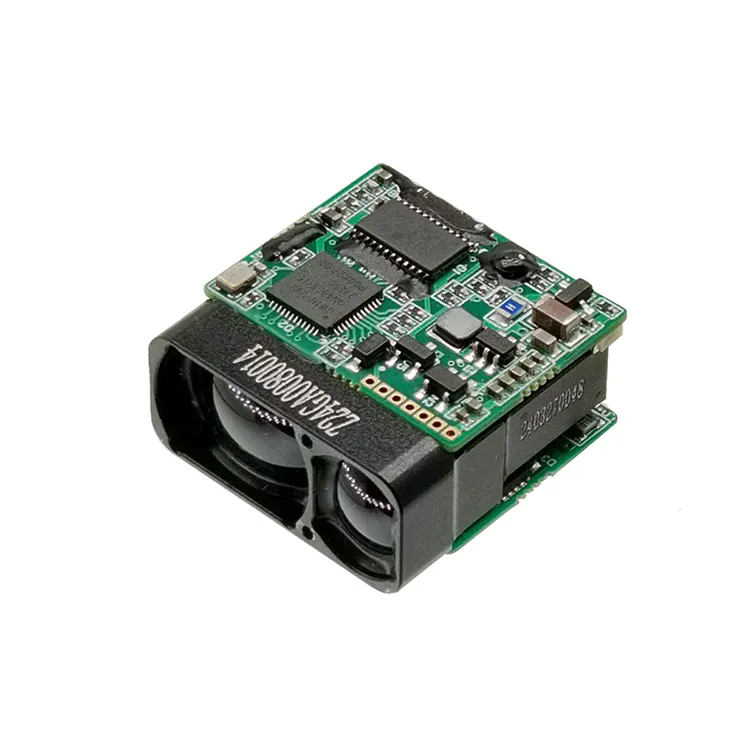
Table of Contents
1. Introduction to Laser Rangefinder Modules
Laser Rangefinder Modules are devices designed to measure distances accurately using laser beams. They are widely applied in robotics, industrial automation, surveying, and consumer electronics. These modules use the time-of-flight (ToF) principle or phase shift measurement to calculate distances, offering high precision, compact design, and fast response times. Understanding the technical specifications and operational capabilities is critical for selecting the right module for any application.
Typical Specifications of a Laser Rangefinder Module:
| Parameter | Specification |
|---|---|
| Measurement Range | 0.05m to 120m |
| Accuracy | ±2mm (short range), ±10mm (long range) |
| Laser Type | Class 1 Eye-Safe Laser (905nm) |
| Operating Voltage | 3.3V – 5V DC |
| Interface | UART / I2C / SPI |
| Measurement Rate | Up to 1000 Hz |
| Operating Temperature | -20°C to +60°C |
| Dimensions | 40mm x 20mm x 10mm |
These parameters demonstrate the versatility of Laser Rangefinder Modules and their suitability for both precise industrial measurements and hobbyist projects.
2. How to Select the Right Laser Rangefinder Module
Selecting the appropriate Laser Rangefinder Module requires careful consideration of measurement requirements, environmental conditions, and integration needs. The following factors are critical:
2.1 Measurement Range Requirements
Consider the maximum and minimum distances to be measured. Modules with longer ranges are suitable for surveying, while short-range modules are ideal for indoor robotics and small-scale automation.
2.2 Accuracy and Resolution
The accuracy of a module affects the reliability of measurements. For applications requiring millimeter precision, select modules with high-resolution sensors. Accuracy typically varies based on distance and reflectivity of the target.
2.3 Interface and Integration
Laser Rangefinder Modules support different communication protocols such as UART, I2C, or SPI. Compatibility with existing controllers or microcontrollers must be verified to ensure seamless integration.
2.4 Environmental Considerations
Modules can be affected by ambient light, temperature, and surface reflectivity. Modules rated for industrial environments typically feature robust casing and temperature tolerance, ensuring consistent performance.
2.5 Power Requirements
Choose modules with voltage and current specifications compatible with your power supply. Low-power modules are preferred for battery-operated systems to extend operational time.
3. Frequently Asked Questions About Laser Rangefinder Modules
Q1: How does a Laser Rangefinder Module measure distance accurately?
A1: Laser Rangefinder Modules use the time-of-flight (ToF) principle, where the laser emits a pulse toward a target and measures the time taken for the reflection to return. The module then calculates the distance based on the speed of light, ensuring precise measurements. Phase shift detection is another method used in some modules, improving accuracy over longer distances.
Q2: What factors affect the measurement accuracy of a Laser Rangefinder Module?
A2: Accuracy depends on distance, target reflectivity, ambient lighting, and environmental conditions. Highly reflective surfaces provide better accuracy, while dark or absorbent surfaces may reduce precision. Proper calibration and stable mounting also enhance measurement reliability.
Q3: Can a Laser Rangefinder Module be used outdoors?
A3: Yes, but outdoor performance is influenced by sunlight and atmospheric conditions. Modules designed with optical filters or higher laser power are more effective in outdoor applications. Industrial-grade modules are suitable for long-range outdoor measurements.
Q4: How do I interface a Laser Rangefinder Module with a microcontroller?
A4: Most modules support UART, I2C, or SPI communication. The microcontroller must be programmed to send measurement commands and read data according to the module’s protocol. Voltage level conversion may be needed if the microcontroller operates at a different voltage than the module.
4. Conclusion and Contact
Laser Rangefinder Modules offer unmatched precision and versatility across multiple industries, from robotics and industrial automation to surveying and scientific research. Choosing the right module involves evaluating measurement range, accuracy, integration interfaces, and environmental tolerance. By understanding the key specifications and application scenarios, professionals can optimize measurement processes and improve operational efficiency.
Jioptik provides high-quality Laser Rangefinder Modules with advanced features, ensuring reliable performance and precise measurements in diverse applications. For further information on product selection, integration support, or technical guidance, contact us to connect with our expert team and explore tailored solutions for your projects.