

Modern households are looking for practical ways to prepare delicious meals without spending excessive time in the kitchen. An Air Fryer has become a popular kitchen appliance because it uses rapidly circulating heated air to cook food with a crisp exterior and a tender interior while requiring little or no added oil for many recipes.
However, buying or using an air fryer successfully involves more than understanding the basic concept. Capacity, heating performance, airflow, cooking programs, basket design, cleaning requirements, safety features, and energy use can all influence the experience. For retailers, distributors, hospitality businesses, and OEM buyers, product consistency and dependable manufacturing are equally important.
This guide explains how an air fryer works, what makes a reliable model practical, how to select the right specifications, how to avoid common cooking problems, and what buyers should consider when sourcing air fryer products.
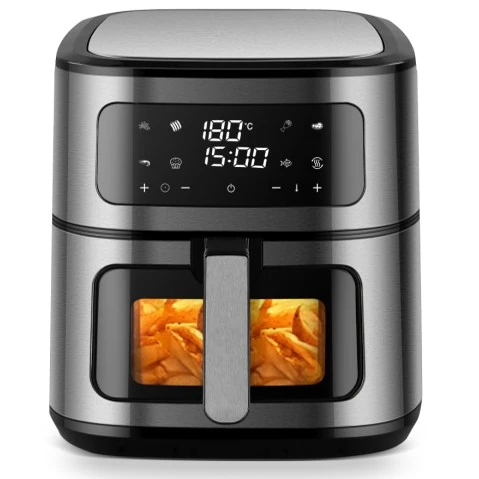
1. Understanding the Air Fryer
An air fryer is a countertop cooking appliance designed to prepare food by circulating heated air around the food chamber. Instead of relying primarily on a large quantity of oil for frying, the appliance uses a heating element and a fan to create a fast-moving hot-air environment.
This cooking method can produce browning and crisping on the surface of foods such as potatoes, chicken, vegetables, fish, and prepared frozen products. The exact result depends on the appliance's temperature range, airflow pattern, cooking chamber, food quantity, and recipe.
Air fryers are available in many configurations. Compact models are suitable for individuals or small households, while larger-capacity units can accommodate family meals. Some designs combine air frying with additional functions such as roasting, baking, reheating, grilling, or dehydrating.
2. How an Air Fryer Works
The basic operating principle is relatively simple, but several components work together to produce consistent cooking results.
Heating Element
The heating element generates the thermal energy required for cooking. Depending on the product design, the heating system may be positioned above or around the cooking chamber. Stable temperature control is important because excessive temperature fluctuations can result in uneven cooking.
High-Speed Air Circulation
A fan moves hot air around the food. This circulation transfers heat to the food surface and helps create the characteristic crisp texture associated with air frying.
Cooking Basket or Tray
The basket allows hot air to reach different sides of the food. A perforated or ventilated structure can improve airflow around the food compared with a solid container.
Temperature and Time Controls
Electronic or mechanical controls allow users to set cooking temperature and duration. More advanced models may provide preset programs, digital displays, memory functions, or sensor-based control.
Heat Management
Good insulation and controlled airflow help keep heat inside the cooking chamber while reducing unnecessary heat transfer to surrounding surfaces. The actual thermal design varies between models and should be evaluated according to product specifications and safety requirements.
3. Key Benefits of Air Fryer Cooking
Less Added Oil for Many Foods
One of the most attractive characteristics of air frying is the ability to prepare many foods with substantially less added oil than conventional deep frying. This can be useful for consumers who want crispy textures while reducing the amount of cooking oil used during preparation.
The nutritional result still depends on the ingredients, recipe, portion size, and preparation method. An air fryer does not automatically make every food nutritionally balanced.
Faster Everyday Meal Preparation
Air fryers can be convenient for smaller portions and quick meals. Many models heat rapidly, reducing the need to preheat a large conventional oven for a small amount of food.
Convenient Operation
Preset programs and straightforward temperature and time controls can make routine cooking easier. Users can prepare common foods without manually managing a pan of hot oil.
Versatile Cooking
Depending on the model, an air fryer can be used for more than frying-style recipes. Roasting vegetables, reheating leftovers, baking small portions, cooking meat, and preparing frozen foods are common uses.
Easy Portion Control
The relatively compact cooking chamber encourages users to prepare appropriately sized portions. For smaller households, this can be more convenient than operating a full-size oven.
| Benefit | Practical Advantage | Important Consideration |
|---|---|---|
| Reduced added oil | Supports low-oil preparation for many recipes | Food ingredients and recipes still determine nutritional value |
| Fast cooking | Useful for quick meals and smaller portions | Cooking time varies by food and quantity |
| Simple controls | Easy to repeat common cooking programs | Users still need to monitor food when necessary |
| Versatility | Supports frying-style cooking, roasting, reheating, and more | Functions depend on the individual model |
4. Important Features to Examine
A well-designed air fryer should balance cooking performance, usability, safety, durability, and maintenance. Buyers should examine the complete product rather than focusing on a single specification.
Digital Temperature Control
Precise temperature adjustment can make it easier to prepare different foods. A clear display and intuitive interface are especially useful for consumers who regularly switch between cooking programs.
Preset Cooking Programs
Presets can simplify preparation for common foods. However, preset programs should be treated as convenient starting points rather than universal guarantees because food quantity and thickness affect cooking results.
Removable Cooking Components
A removable basket or tray makes cleaning considerably easier. Dishwasher compatibility, where supported by the manufacturer, can provide additional convenience.
Safety Features
Useful safety features may include automatic shutoff, overheating protection, secure basket mechanisms, insulated handles, and stable feet. Exact features vary by product and should be confirmed through product documentation.
Noise and Operating Comfort
Because air fryers use a fan, operating noise is an important part of the user experience. Efficient fan design can help provide effective airflow without creating unnecessarily disruptive noise.
5. Capacity and Cooking Space
Capacity is one of the most important factors when selecting an air fryer. A compact unit may be ideal for one or two people, while larger families may need substantially more cooking space.
| Typical Capacity Category | Suitable Scenario | Main Consideration |
|---|---|---|
| Compact | Single users and small portions | Small footprint and limited batch size |
| Medium | Couples and small families | Balance between capacity and countertop space |
| Large | Families and larger meal preparation | Higher capacity and potentially greater power requirements |
| Extra-large | Large households or frequent batch cooking | Requires adequate space and suitable electrical supply |
Capacity should not be judged solely by the manufacturer's stated volume. The usable cooking area and basket geometry can be equally important. Food may cook differently when it is piled too deeply because hot air cannot circulate evenly around every piece.
For foods that need crisp surfaces, spreading ingredients in a relatively even layer is often more effective than filling the basket to maximum capacity. Users should follow the operating instructions supplied with the specific appliance.
6. Heating and Airflow Performance
Cooking consistency depends heavily on how efficiently the appliance transfers heat to food. Two air fryers with similar power ratings can produce different results because their airflow paths, fan designs, heating elements, and cooking chambers may differ.
Stable Temperature
A reliable temperature control system helps maintain predictable cooking conditions. Excessive fluctuations may increase cooking times or cause some foods to brown too quickly on the outside.
Uniform Air Distribution
Air should circulate effectively around the cooking basket. Poor airflow can result in one side of the food becoming crisp while another remains undercooked.
Appropriate Power
Higher power does not automatically mean better performance. Heating capacity should be balanced with chamber size, thermal insulation, airflow, temperature control, and electrical requirements.
7. Common Household and Commercial Applications
Home Kitchens
Home users commonly prepare French fries, chicken wings, vegetables, fish, snacks, and reheated foods. The compact format makes the appliance useful when users want quick meals without operating a full-size oven.
Small Apartments and Dormitories
Compact air fryers can be particularly useful where kitchen space is limited. Their relatively small footprint makes them practical for countertop cooking, provided that ventilation and electrical requirements are properly observed.
Restaurants and Food Service
Commercial food-service operations may use air-frying technology for selected menu items. Commercial equipment typically requires higher capacity, more robust construction, and different duty-cycle considerations than household appliances.
Retail and Private-Label Products
For distributors and retailers, air fryers can be developed with different capacities, appearances, control interfaces, packaging designs, and feature combinations. OEM and ODM programs may allow brands to develop products aligned with their target market.
8. How to Choose a Suitable Air Fryer
Whether you are a consumer, retailer, distributor, or project buyer, selection should begin with actual usage requirements.
1. Define the Intended User
Determine whether the product is intended for individuals, families, restaurants, hotels, catering businesses, or another customer group. This affects capacity, controls, construction, and expected operating frequency.
2. Determine Required Capacity
Estimate typical batch sizes rather than choosing capacity based only on occasional large meals. Oversized equipment can occupy unnecessary space, while an undersized basket can make users cook several batches.
3. Review Temperature and Time Controls
Confirm the temperature range, timer range, control method, display type, and available presets. Different markets may have different expectations regarding control interfaces.
4. Evaluate Cleaning Requirements
Food residue can accumulate quickly around baskets and cooking chambers. Removable components and accessible surfaces can make regular cleaning easier.
5. Consider Safety
- Check for overheating protection.
- Confirm secure basket or drawer construction.
- Evaluate handle insulation and external surface temperature.
- Provide adequate clearance around the appliance during operation.
- Confirm the electrical specification for the intended market.
6. Consider Long-Term Product Reliability
For commercial buyers, reliability is especially important because frequent product failures can generate warranty claims and damage customer confidence. Suppliers should be able to provide appropriate technical documentation, inspection information, and after-sales support.
9. Common Cooking Problems and Solutions
| Problem | Possible Cause | Practical Solution |
|---|---|---|
| Food is not crispy | Basket overloaded or insufficient airflow | Reduce the batch size and distribute food more evenly |
| Food cooks unevenly | Food pieces are different sizes or airflow is obstructed | Cut food consistently and arrange it with sufficient space |
| Food becomes too dry | Temperature or cooking time is excessive | Reduce cooking time or temperature and monitor progress |
| Strong odor during use | Residue, new-appliance odor, or unsuitable food preparation | Clean the unit according to instructions and ensure proper ventilation |
| Appliance overheats | Blocked ventilation or improper placement | Maintain required clearance and keep ventilation openings unobstructed |
Avoid Overfilling the Basket
One of the most common user mistakes is placing too much food in the basket. Air frying relies on circulation, so excessive loading can interfere with heat transfer and produce inconsistent results.
Do Not Ignore Food Thickness
Cooking time depends not only on weight but also on food thickness and starting temperature. Thick pieces may require considerably more time than thin pieces of the same food.
Use Appropriate Accessories
Accessories should be compatible with the appliance and should not block important airflow paths. Users should always follow the manufacturer's instructions for approved accessories.
10. Cleaning and Maintenance
Regular cleaning is essential for maintaining hygiene, performance, and product appearance. Food residue and accumulated grease can affect airflow and produce unwanted odors.
After Each Use
- Allow the appliance to cool sufficiently before cleaning.
- Remove the basket or tray according to the product instructions.
- Remove food residue and grease.
- Clean removable components using the recommended method.
- Wipe accessible internal and external surfaces appropriately.
- Keep electrical components and controls away from direct water exposure.
Periodic Inspection
Check the basket coating, handle, power cord, plug, ventilation openings, and housing for visible damage. If a component becomes damaged, discontinue use when necessary and follow the manufacturer's repair or replacement guidance.
For commercial equipment, cleaning schedules should be integrated into the site's routine maintenance procedures. Frequent users should pay particular attention to grease accumulation and airflow passages.
11. What Buyers Should Consider When Sourcing Air Fryers
Businesses purchasing air fryers for resale, private-label programs, hospitality projects, or distribution need to evaluate the supplier as carefully as the product itself.
Product Specifications
Request complete information covering rated power, voltage, frequency, capacity, temperature range, timer range, control interface, materials, basket construction, dimensions, and safety features.
Quality Control
Consistent manufacturing is important when ordering products in volume. Ask about incoming material inspection, production checks, functional testing, electrical testing, and final inspection procedures where appropriate.
Market Requirements
Electrical appliances are subject to different regulatory and certification requirements depending on the destination market. Importers should identify applicable requirements before mass production and shipment.
Customization
Retail brands may require customized colors, logos, packaging, control panels, capacities, or functional configurations. Discuss these requirements at the beginning of the project so they can be evaluated for feasibility.
Packaging and Transportation
Air fryers contain electrical and mechanical components that should be protected during transportation. Packaging design should account for product weight, fragile areas, stacking, handling, and expected shipping conditions.
- Complete product specifications
- Stable manufacturing capacity
- Quality inspection procedures
- Applicable product testing and documentation
- OEM/ODM customization capability
- Clear communication and technical support
- Reliable packaging and shipment preparation
Ningbo Yah Technology Co., Ltd. provides air fryer-related product solutions for customers seeking practical kitchen appliance designs and manufacturing support. For distributors and brands, discussing target capacity, functions, market requirements, and customization expectations in advance can help create a more suitable product specification.
12. Frequently Asked Questions
1. What is an Air Fryer?
An air fryer is a countertop cooking appliance that uses a heating element and circulating hot air to cook food. It can create browned and crisp surfaces while requiring little or no added oil for many recipes.
2. Does an Air Fryer use oil?
Many foods can be cooked with little or no added oil. Some recipes benefit from a small amount of oil for browning or texture, depending on the ingredients and desired result.
3. Can an Air Fryer replace a conventional oven?
An air fryer can perform some functions similar to a small convection oven, but it does not necessarily replace a conventional oven for every cooking requirement. Capacity and cooking space are major differences.
4. Why does food sometimes cook unevenly in an Air Fryer?
Overloading the basket, using different food sizes, or restricting airflow can cause uneven cooking. Smaller batches and more even food distribution generally improve circulation.
5. How do I choose the right Air Fryer capacity?
Consider the number of people being served, typical portion sizes, available countertop space, and how frequently multiple batches are required. The physical cooking area is also important, not just the stated volume.
6. Are Air Fryers easy to clean?
Many models include removable baskets or trays that make cleaning easier. The exact cleaning method depends on the product construction, coating, and manufacturer instructions.
7. What features are important in an Air Fryer?
Important features may include temperature control, timer settings, preset programs, removable cooking components, overheating protection, insulated handles, effective airflow, and an easy-to-use control interface.
8. Is a higher wattage Air Fryer always better?
Not necessarily. Cooking performance depends on the complete thermal system, including heating power, airflow, chamber design, temperature control, and insulation. Wattage should be considered together with these factors.
9. What should distributors consider when buying Air Fryers in bulk?
Distributors should evaluate product specifications, quality consistency, applicable market requirements, packaging, customization capabilities, production capacity, inspection procedures, lead times, and after-sales support.
10. Can Ningbo Yah Technology Co., Ltd. support customized Air Fryer requirements?
Ningbo Yah Technology Co., Ltd. can discuss product requirements with customers looking for air fryer solutions. Buyers should provide details such as capacity, electrical requirements, desired functions, appearance, packaging, target market, and expected order volume.
13. Final Thoughts: Making Air Frying More Practical
The popularity of the air fryer comes from a simple idea: making everyday cooking more convenient without relying on traditional deep-frying methods. By combining controlled heating with rapid air circulation, the appliance can prepare a wide variety of foods while fitting comfortably into modern kitchen routines.
For consumers, the most important considerations are capacity, ease of use, cooking performance, cleaning, and safety. For distributors and brands, the decision goes further and includes product consistency, customization, compliance requirements, packaging, manufacturing capacity, and long-term supplier support.
Choosing an air fryer based on actual application requirements rather than marketing claims can lead to a better product experience and fewer operational problems. Whether the goal is a compact household appliance, a larger family model, or a customized product for a commercial market, careful specification is the foundation of a successful solution.
Looking for a Reliable Air Fryer Manufacturing Partner?
Ningbo Yah Technology Co., Ltd. provides kitchen appliance solutions for customers seeking practical, functional, and market-oriented products. From product specifications and capacity planning to customization and manufacturing requirements, the right development process can help create an air fryer suited to your target market.
Whether you are a distributor, retailer, importer, private-label brand, or commercial buyer, share your requirements for capacity, functions, electrical specifications, appearance, packaging, and order volume so the product solution can be evaluated more effectively.
If you are planning to source an Air Fryer for your business, contact us today to discuss your product requirements and explore a suitable manufacturing solution with Ningbo Yah Technology Co., Ltd.
Explore Ningbo Yah Technology Co., Ltd.Technical note: Product features, capacities, electrical specifications, safety functions, certifications, and applicable cooking performance vary by model and market. Always consult the relevant product documentation and applicable local requirements before purchase, production, or use.