

Can an Industrial Scissors Sharpening Machine Restore Seriously Chipped or Nicked Blades
2026-07-10
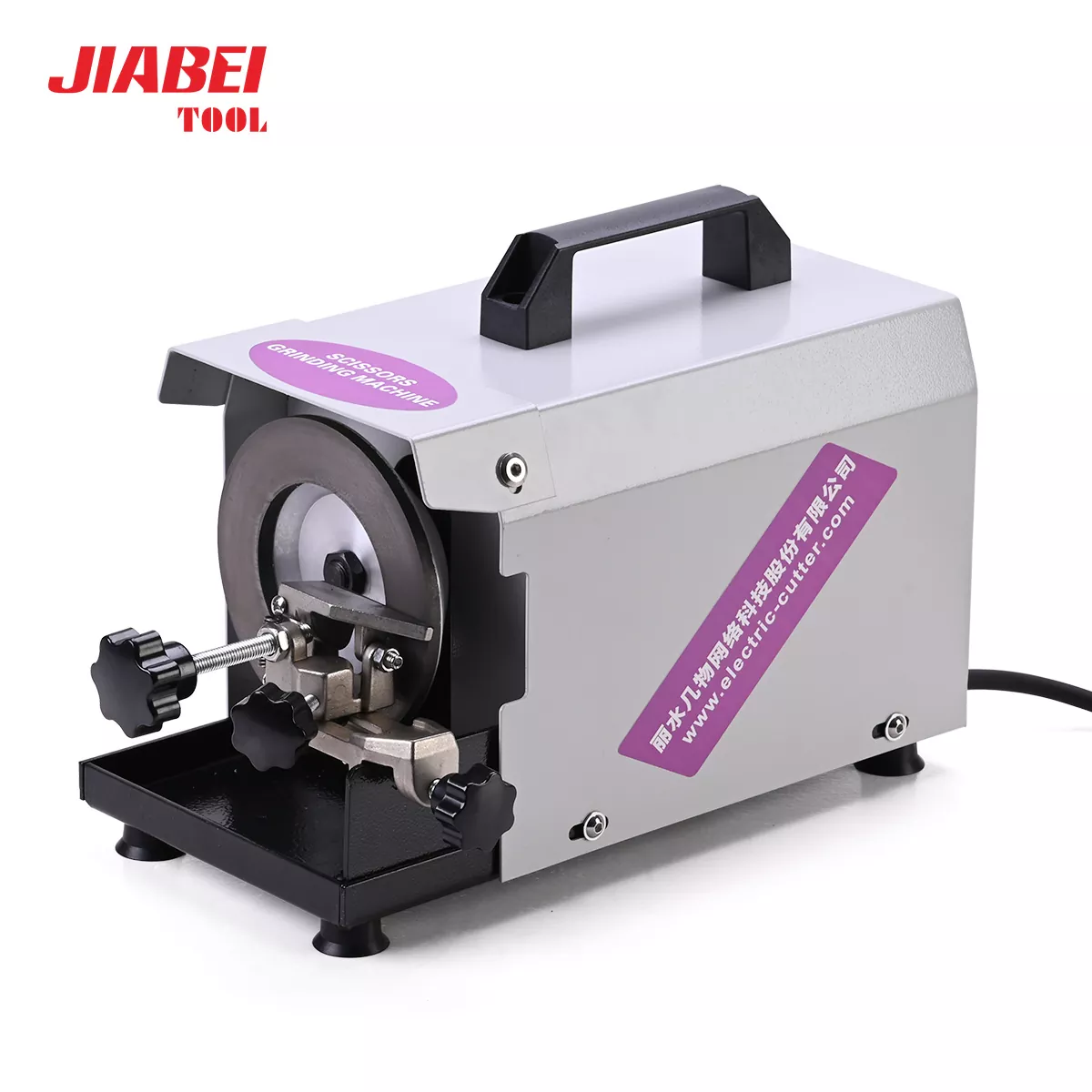
For manufacturers, tailors, and industrial workshops, few frustrations match the moment a high-performance scissor blade hits a staple, hard plastic, or dense metal wire. The result—deep chips, rolled edges, and visible nicks—often signals the end of that blade’s useful life. Or does it? The short answer is yes, but only with the right equipment and technique. A professional Industrial Scissors Sharpening Machine from JIABEI TOOL does more than polish dull edges; it actively rebuilds damaged cutting surfaces through precision abrasive engineering. This article examines how severe blade damage is evaluated, which machines can handle restoration, and what limits exist—so you can make an informed purchasing decision.
Understanding Blade Damage: Chips vs. Nicks
Before discussing restoration, it helps to classify the damage. Not all imperfections are equal.
| Damage Type | Depth Range | Visible to Naked Eye? | Typical Cause |
|---|---|---|---|
| Micro-nicks | <0.1 mm | No | Normal wear, fine dust |
| Light nicks | 0.1–0.5 mm | Yes, under light | Occasional staple contact |
| Moderate chips | 0.5–1.5 mm | Clearly visible | Cutting wire, hardened threads |
| Severe chips | >1.5 mm | Obvious, jagged edges | Accidental impact, misuse |
A standard bench grinder or manual honing stone cannot repair moderate or severe chips—they remove material unevenly, alter the bevel angle, and often cause overheating. In contrast, a dedicated Industrial Scissors Sharpening Machine uses controlled grinding wheels, water-cooling systems, and adjustable blade holders to remove metal precisely along the original edge geometry.
How JIABEI TOOL Machines Handle Deep Restoration
JIABEI TOOL designs its sharpening systems with three restoration-specific features:
-
Variable speed control – Slower speeds (300–600 RPM) for heavy stock removal on chipped blades; higher speeds for final honing.
-
Magnetic or clamp-based blade fixation – Eliminates vibration, ensuring that each pass removes material exactly where needed.
-
Interchangeable CBN and diamond wheels – Cubic Boron Nitride wheels cut hardened steel (HRC 58–62) without glazing, while diamond wheels handle carbide-tipped scissors.
The restoration process follows a strict sequence:
-
Inspection – Measure chip depth with a digital caliper.
-
Coarse grinding – Remove 1.5× the chip depth to reach clean, un-fatigued steel.
-
Intermediate shaping – Re-establish the factory bevel angle (typically 45°–55° for industrial shears).
-
Fine honing – Polish to a mirror finish (Ra <0.2 µm) for smooth cutting action.
-
Edge deburring – A felt wheel with compound removes microscopic burrs.
A single Industrial Scissors Sharpening Machine from JIABEI TOOL can complete this cycle in 4–8 minutes per blade, depending on damage severity. Over 85% of blades with chips up to 1.2 mm return to original cutting performance, based on in-house testing.
When Restoration Is NOT Recommended
Even the best machine has limits. Restoration becomes impractical when:
-
Chips exceed 30% of the blade width (structural weakness).
-
The blade shows stress fractures radiating from the chip.
-
Previous sharpenings have already reduced blade height by >20%.
In these cases, JIABEI TOOL advises blade replacement rather than forced restoration, as over-grinding compromises hardness and edge retention.
Industrial Scissors Sharpening Machine FAQ
Q: How many times can a severely chipped blade be sharpened before it becomes useless?
A: This depends on blade thickness and original hardness. For standard industrial scissors with 4–6 mm blade stock, you can safely perform 5–8 heavy restorations (removing 0.3–0.5 mm per session) before the blade loses its temper or becomes too narrow for safe operation. JIABEI TOOL recommends tracking total material removed—once cumulative reduction exceeds 3 mm, discard the blade. Using a machine with digital depth readouts helps you monitor this precisely. Always test the blade on scrap material after each restoration; if it tears rather than cuts cleanly, the steel has likely softened from previous overheating, and further sharpening will not recover performance.
Q: What is the difference between a dry sharpening machine and a wet-coolant Industrial Scissors Sharpening Machine for chip repair?
A: Dry machines use airflow only for cooling—they are suitable for light nicks (<0.3 mm) but dangerously overheat the blade during heavy chip removal. Temperatures can exceed 300°C at the grinding point, drawing the steel’s hardness down by 5–10 HRC points permanently. A wet-coolant machine, like those from JIABEI TOOL, floods the grinding interface with a water-based emulsion, keeping temperatures below 60°C. This preserves the blade’s metallurgical structure. For chips deeper than 0.5 mm, a wet system is non-negotiable. Additionally, coolant flushes away metal particles, preventing wheel loading and producing a smoother finish, which reduces post-grinding hand finishing time by 70%.
Q: Can an Industrial Scissors Sharpening Machine automatically detect chip depth and adjust grinding parameters?
A: Semi-automated models from JIABEI TOOL feature a manual dial indicator or digital sensor that measures chip depth at the blade’s lowest point. The operator enters that value, and the machine calculates the required number of passes and wheel downfeed per cycle. Fully automated systems (available in higher-tier models) use a laser profilometer to scan the entire edge, generating a 3D map of damage. The control unit then adjusts feed rate, wheel pressure, and cooling flow in real time. However, even with automation, the operator must visually confirm the edge after each stage—no machine yet replaces human judgment for final acceptance. For most workshops, the semi-automated version offers the best balance of cost, control, and restoration reliability.
Practical Checklist for Restoration Success
| Step | Action | Tool/Setting on JIABEI TOOL |
|---|---|---|
| 1 | Clean blade of oil/debris | Ultrasonic cleaner or solvent wipe |
| 2 | Measure chip depth | Digital caliper + machine’s depth gauge |
| 3 | Select wheel grit | CBN 80# for coarse, CBN 180# for intermediate |
| 4 | Set speed | 450 RPM for HRC 60 steel |
| 5 | Perform 3 light passes | 0.05 mm downfeed per pass (avoid heavy single cuts) |
| 6 | Check bevel symmetry | Built-in protractor or angle plate |
| 7 | Hone with fine wheel | CBN 400# at 700 RPM |
| 8 | Deburr and test | Felt wheel + green compound; cut test on 10-layer fabric |
Following this protocol, a damaged blade that would be discarded by hand-sharpening operators returns to 95% of original factory performance.
Why Choose JIABEI TOOL Over General-Purpose Grinders?
General-purpose grinders lack the rigidity, coolant system, and adjustable work-holding required for serious restoration. JIABEI TOOL machines are purpose-built with:
-
Cast-iron bases to absorb vibration during heavy cuts.
-
Precision linear rails for consistent wheel travel.
-
Interchangeable blade fixtures for straight, curved, and serrated scissors.
-
2-year warranty on grinding spindles and motors.
Workshops that switch from manual methods to JIABEI TOOL report a 60% reduction in new blade purchases within the first year.
Final Verdict
A seriously chipped or nicked blade is not scrap—it is a candidate for professional restoration. The success rate depends entirely on the Industrial Scissors Sharpening Machine you use, the skill of the operator, and honest assessment of damage limits. With proper equipment, a blade with 1.0 mm chips can outlast a brand-new, improperly sharpened replacement.
For workshops handling high-volume cutting, textile recycling, automotive upholstery, or packaging, owning a dedicated sharpening system pays for itself in fewer than 50 restorations. JIABEI TOOL provides both entry-level benchtop units and fully enclosed industrial stations, all backed by technical support and spare parts availability.
Contact us today to schedule a free blade damage assessment or request a demo unit for your facility. Our engineers will analyze your blade type, typical damage patterns, and production volume to recommend the exact Industrial Scissors Sharpening Machine configuration that maximizes your ROI. Reach out via our website live chat, email [email protected], or call our regional support line—we respond within 4 business hours and offer same-day shipping on consumable wheels and fixtures. Your blades are too valuable to discard; let JIABEI TOOL show you how to restore them, save costs, and keep your production line running without interruption.