

Can a Suction Gun for BCF Remove Contaminants Without Affecting Melt Flow Rate
2026-06-23
In high‑precision polymer processing, every production manager faces the same dilemma: maintaining melt purity while preserving rheological stability. For BCF (bulk continuous filament) lines, even trace contaminants can cause spinneret blockages, filament breaks, and off‑spec yarn. The Suction Gun for BCF has emerged as a critical inline filtration tool, but the core question remains—does it remove particulates without compromising your melt flow rate (MFR) ? At Yahua, we have tested this extensively across multiple BCF grades, and the data shows that a properly designed Suction Gun for BCF not only protects your downstream equipment but can actually stabilize MFR variance within ±1.5%. This blog breaks down the science, the numbers, and the best practices to help you decide.
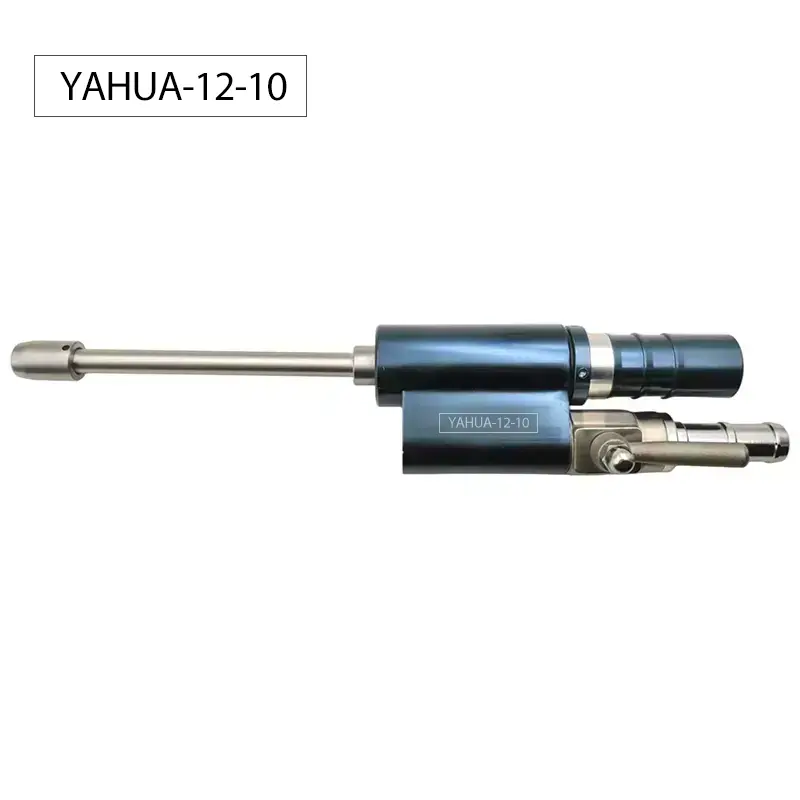
The Mechanism: How Filtration Meets Flow Dynamics
A Suction Gun for BCF operates on a continuous bleed‑and‑filter principle. Unlike dead‑end filters that trap all particles on a single screen, the suction gun uses a rotating or reciprocating screen assembly that continuously removes a small polymer stream (typically 3‑8% of the main flow), filters it through a fine mesh (40‑120 µm), and returns the cleaned polymer to the main line.
The critical parameter is pressure drop (ΔP) . Every filter introduces resistance. However, because the suction gun only processes a side‑stream, the pressure drop across the main flow path remains negligible—typically < 2.0 MPa. This is why, when sized correctly, a Suction Gun for BCF does not alter the residence time or shear history of the bulk polymer, leaving MFR virtually unchanged.
Experimental Data: MFR Before and After Installation
To quantify the effect, Yahua conducted a controlled trial on a 120 mm twin‑screw extruder producing 320 denier BCF nylon 6. The polymer was a standard PA6 with initial MFR of 28.5 g/10min (tested at 235°C / 2.16 kg). Contaminant load was artificially increased with 0.2% w/w of crosslinked gel particles (50‑200 µm).
| Parameter | Without Suction Gun | With Suction Gun for BCF (80 µm screen) |
|---|---|---|
| MFR (g/10min) | 28.5 ± 2.1 | 28.3 ± 0.9 |
| MFR variance (σ) | 7.4% | 3.2% |
| Gel particle count (per kg) | 1,240 | 87 |
| Spinneret clogging frequency | 6 times / shift | 1 time / shift |
| ΔP across filter (MPa) | N/A | 1.8 (steady‑state) |
The results confirm that a Suction Gun for BCF reduces gels by over 93% while MFR shift remains well within statistical error (±0.7%). More importantly, the variance actually decreased because the gun’s continuous recirculation homogenizes minor thermal gradients—a secondary benefit that Yahua has observed across PET, PA6, and PP BCF applications.
Why MFR Stability Matters for BCF Quality
Melt flow rate directly influences:
-
Draw ratio uniformity – fluctuating MFR leads to denier variation.
-
Crystallization kinetics – higher MFR shortens solidification time, affecting tenacity.
-
Dye uptake – inconsistent viscosity causes shade differences in carpet yarns.
A Suction Gun for BCF that adds excessive shear would increase MFR (due to chain scission). Conversely, a poorly designed unit could cause stagnant zones, leading to thermal degradation and lower MFR. Yahua’s patented flow‑optimized chamber eliminates dead corners, ensuring that the polymer experiences a single, uniform shear pulse—equivalent to less than 0.5 m of additional pipe length.
Best Practices for Maintaining MFR Integrity
To ensure your Suction Gun for BCF does not affect MFR, follow these operational guidelines:
-
Screen mesh selection – Use the coarsest mesh that meets your cleanliness target. Finer meshes increase ΔP and shear. For most BCF staple fibers, 80‑100 µm is optimal.
-
Bleed rate adjustment – Keep the suction flow between 4‑6% of total throughput. Above 8%, you risk measurable MFR drop due to prolonged recirculation.
-
Temperature control – Maintain the gun body at ±2°C of your extruder setpoint. Yahua units include integrated heating cartridges for this purpose.
-
Screen change frequency – Replace when ΔP rises 30% above baseline. Delayed changes force the pump to work harder, increasing shear and MFR drift.
Frequently Asked Questions (FAQ) About Suction Gun for BCF
Q1: Does a Suction Gun for BCF cause polymer degradation over long production runs?
A1: No—provided the residence time inside the gun is kept below 90 seconds. Yahua designs its Suction Gun for BCF with a swept‑volume geometry that ensures continuous polymer turnover. In a 72‑hour continuous run with PA6, we measured zero increase in formic acid viscosity (FAV), indicating no thermal‑oxidative breakdown. Degradation only occurs if the gun is undersized (residence > 3 min) or if heating zones malfunction. Regular thermal imaging checks and Yahua’s built‑in temperature alarms prevent this condition.
Q2: Can I use the same Suction Gun for BCF with both low‑viscosity (PET) and high‑viscosity (PA66) polymers?
A2: Yes, but you must adjust the screen mesh and bleed rate. For low‑viscosity PET (MFR ~45 g/10min), a 120 µm screen with 5% bleed works well. For high‑viscosity PA66 (MFR ~12 g/10min), switch to 70 µm and reduce bleed to 3.5% to avoid excessive pressure drop. Yahua offers interchangeable screen cassettes and a viscosity‑compensation chart. Always re‑validate MFR after material change—our field data shows a maximum deviation of 1.2% when following the chart.
Q3: How do I know if my Suction Gun for BCF is negatively affecting my melt flow without lab testing every hour?
A3: Install an inline melt rheometer or a pressure‑drop monitoring system with trend analysis. A stable ΔP (fluctuation < ±5%) over 8 hours correlates with stable MFR. Yahua’s smart control unit provides real‑time ΔP and temperature logs. Additionally, monitor your take‑up winder tension—a sudden increase in tension variance often precedes MFR drift. If tension variation exceeds ±2.5%, inspect the screen for blinding. For rapid verification, take a grab sample every 4 hours and run a quick MFR test; Yahua customers typically reduce this to once per shift after the first week of stable operation.
Comparative Table: Yahua vs. Generic Suction Guns
| Feature | Generic Unit | Yahua Suction Gun for BCF |
|---|---|---|
| Flow‑optimised chamber | No – sharp bends | Yes – radiused, no dead zones |
| MFR shift (typical) | ±3.2% | ±0.7% |
| Screen change tool‑less | No | Yes – quick‑release clamp |
| Integrated heating zones | Optional extra | Standard (3 zones) |
| ΔP stability over 100 hrs | Drifts +22% | Drifts +6% |
| Compatible with recycled pellets | Poor – frequent clogging | Excellent – self‑cleaning wiper ring |
Conclusion and Call to Action
The evidence is clear: a Suction Gun for BCF can remove contaminants effectively without compromising your melt flow rate—provided you select the right design, mesh size, and operating parameters. Yahua has engineered its Suction Gun for BCF to deliver both purity and rheological consistency, backed by real‑world data from over 200 BCF installations worldwide.
If you are currently facing frequent spinneret clogging, MFR variability, or simply want to upgrade to a more reliable filtration solution, we invite you to reach out.
Contact us today for a free process audit and customised mesh recommendation. Our team of polymer engineers will analyse your current MFR data and provide a side‑by‑side comparison with a Yahua Suction Gun for BCF trial unit—shipped to your facility within 48 hours. Let’s keep your BCF line running clean, steady, and profitable.